About the R.S. Surtees Society
Setting
During WWII, in 1942, the Eighth Army struggled with Rommel’s Afrika Korps. However, under the command of General Bernard Montgomery Rommel’s advance was stopped at the Battle of Alam el Halfa, and a decisive victory was achieved at the Second Battle of El Alamein in late 1942. The tide had turned. At this time, RS Surtees Society was conceived by Sir Kenneth Pickthorn Bt.
Sir Kenneth served in the 15th London Regiment and Royal Air Force during WWI and became a notable politician and academic, being President of Corpus Christi College, Cambridge from 1937 to 1944. As the Eighth Army struggled and then became victorious, the R.S. Surtees Society was formed. Its conception was minuted in the Michaelmas term papers of the Cambridge Conservative Association. However, like many things great and good, the decision was not immediately put into effect. Sir Kenneth passed the Society’s responsibilities to his son, Sir Charles Pickthorn Bt.
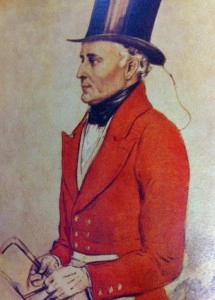
R.S.Surtees-1
R.S. Surtees 1805 - 1864
Evolution…
A feeling that the job was done saw the founding fathers of the Society propose withdrawing their funds and winding the Society up. However, a new Executive Committee was appointed at an extraordinary general meeting in the Linnaean Society (a society dedicated to the study and dissemination of information concerning natural history, evolution, and taxonomy and in particular manuscripts and literature collections). On Sir Charles’ death in 1995, Lady Helen Pickthorn took on the Society, running it with great elegance and verve until 2011, when she handed the reins to Rob Williams.

If in the opinion of the Committee it is considered advisable to raise funds to achieve the above stated objects the Society may publish or republish works by other authors, or prints by artists, or other items of literary or artistic association; and to do anything else which is lawful and shall be approved beforehand by the members voting in person or by proxy at a General Meeting of the Society.
Aims of the Society
1
2
3
If in the opinion of the Committee it is considered advisable to raise funds to achieve the above stated objects the Society may publish or republish works by other authors, or prints by artists, or other items of literary or artistic association; and to do anything else which is lawful and shall be approved beforehand by the members voting in person or by proxy at a General Meeting of the Society.
About R.S. Surtees

I never push myself an inch forward, but I damned well see that I am never pushed an inch back.

He said, at a time when the sentiment was finding heroic expression in the stand of the 93rd Highlanders at Balaclava.
Robert Smith Surtees was born at Hamsterley Hall, County Durham. It was the locus from which all his novels proceeded, and from which he ranged in his pursuit of foxhunting.
In 1822 he was dispatched to London to be articled to a solicitor. Bored with the life there he switched to writing sporting journalism on the subject dearest to his heart – hunting. He soon founded his own periodical – The New Sporting Magazine – and for the rest of his life he wrote and hunted.
How did Surtees consider his position? A contemporary captured it very neatly, refusing Lord Palmerston’s peerage with the words:
…with no disrespect to the House of Lords, I consider there is no position higher than that of an English country gentleman.